SORA 2.5 Ground Risk Buffer Calculator
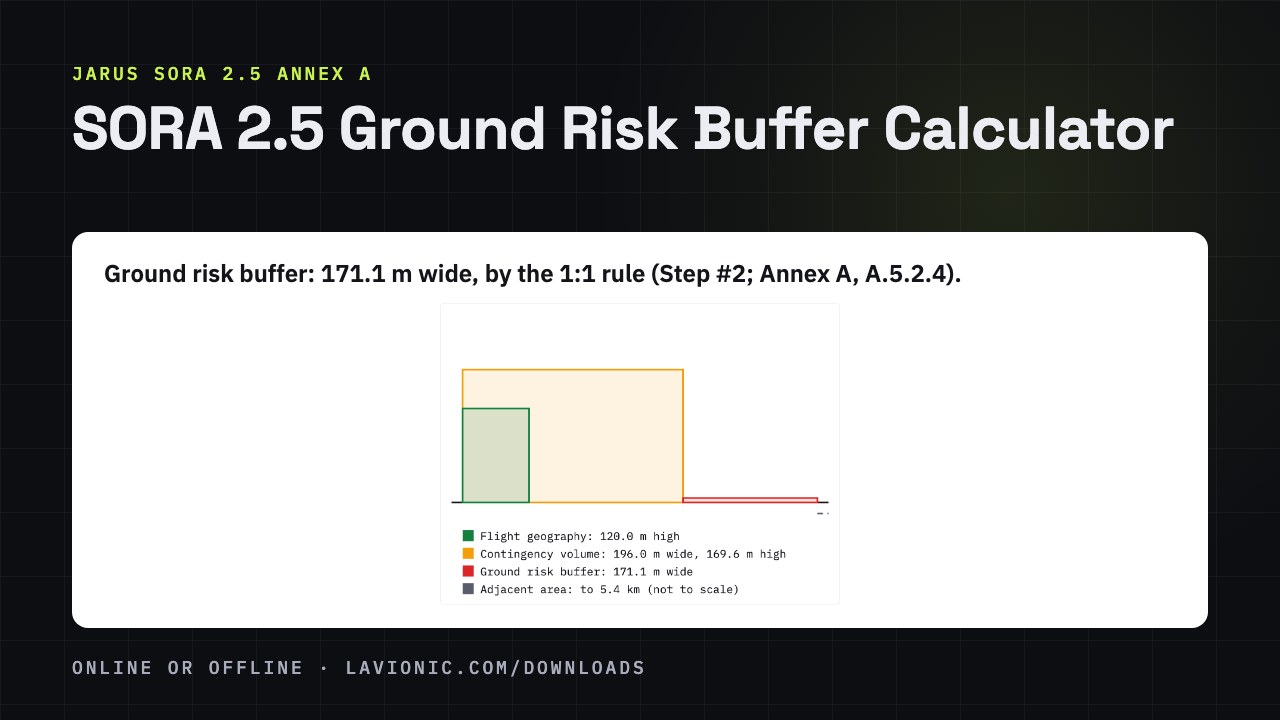
Answer up to ten short questions about your aircraft and your flight geography. The calculator shows the contingency volume, the ground risk buffer, the iGRC footprint and the adjacent area, with a side view drawn to scale.
v0.1 · 2026-10-24 · HTML · works offline
What this is
SORA 2.5 puts a contingency volume around the flight geography and a ground risk buffer on the ground around both. The adjacent area lies beyond the buffer. The tool calculates their size from the aircraft type, the largest dimension, the maximum speed and the height of the flight geography. It uses the sample formulas of Annex A, A.5.2.3 and A.5.2.4, and the 3-minute rule of Step #8.
What you enter
- The type of aircraft: a multirotor or helicopter, or a fixed wing.
- Its largest dimension and its maximum speed.
- The height of the top of your flight geography, and whether the aircraft measures its height by barometer or by GNSS.
- What the aircraft does when it leaves the flight geography: a manoeuvre back, or a parachute that opens at once.
- How the flight ends if it also leaves the contingency volume: the 1:1 rule, a ballistic fall (multirotor or helicopter), a glide (fixed wing) or a parachute, with the values that method needs.
What you get
- The width and the height of the contingency volume.
- The width of the ground risk buffer, by the method you chose.
- The iGRC footprint: from the edge of the flight geography to the outer limit of the buffer.
- The outer limit of the adjacent area: 3 minutes at the maximum speed, at least 5 km and at most 35 km.
- A side view of the volumes and the buffer, drawn to scale, and every term of the calculation with its formula.
- An edit panel: change one answer or an Annex A default value and the result follows at once.
Terms
- Flight geography: the space in which you plan to fly in normal operation. Its edge should leave room for navigation, flight and map errors (Main Body 2.2.2; EASA S.2.2.2).
- Contingency volume: the space around the flight geography. When the aircraft goes into it, the crew uses the contingency procedures to bring the aircraft back. Its outer edge is the edge of the operational volume (Main Body 2.2.3; Annex A, A.5.2.3).
- Operational volume: the flight geography and the contingency volume together (EASA Annex I, I.101).
- Ground risk buffer: the strip of ground around the operational volume. If the aircraft also leaves the contingency volume, its flight should come down inside this strip (Main Body 2.2.4; Annex A, A.5.2.4).
- iGRC footprint: the operational volume on the ground plus the ground risk buffer. Step #2 uses the population density of this area for the intrinsic ground risk class.
- Adjacent area: the ground outside the ground risk buffer where the aircraft can come down after a flyaway. Its outer limit is the distance the aircraft flies at its maximum speed for 3 minutes, from the operational volume, at least 5 km and at most 35 km (Main Body 2.2.5 and Step #8). EASA calls it the adjacent ground area.
- 1:1 rule: the simple method for the ground risk buffer. The buffer is as wide as the contingency volume is high, plus half the characteristic dimension. For a fixed wing it fits only when the controls are set so that the aircraft cannot glide (Annex A, A.5.2.4).
- Characteristic dimension: the longest straight line across the aircraft, with the rotors and propellers in their worst position (Main Body Step #2; Annex A, A.5.2.1).
Online or offline
Use it online in your browser, or download it once as one HTML file. The file opens in Chrome, Safari, Edge or Firefox, works without an internet connection and sends no data anywhere.
The calculator uses the sample formulas and default values of Annex A, A.5.2. It does not check the width of the flight geography, the population density and the iGRC (the SORA SAIL Calculator does that), the containment level, an aircraft of 250 g or less, or the air risk buffer.
The calculator is an aid, not a means of compliance. Your competent authority decides.
Sources
- JARUS SORA 2.5 Main Body (sections 2.2.2 to 2.2.5, Steps #2 and #8) and Annex A (A.5.2)
- EASA Easy Access Rules for UAS (June 2026): AMC1 Article 11 and its Annex A